
- 0
- 1,256 word
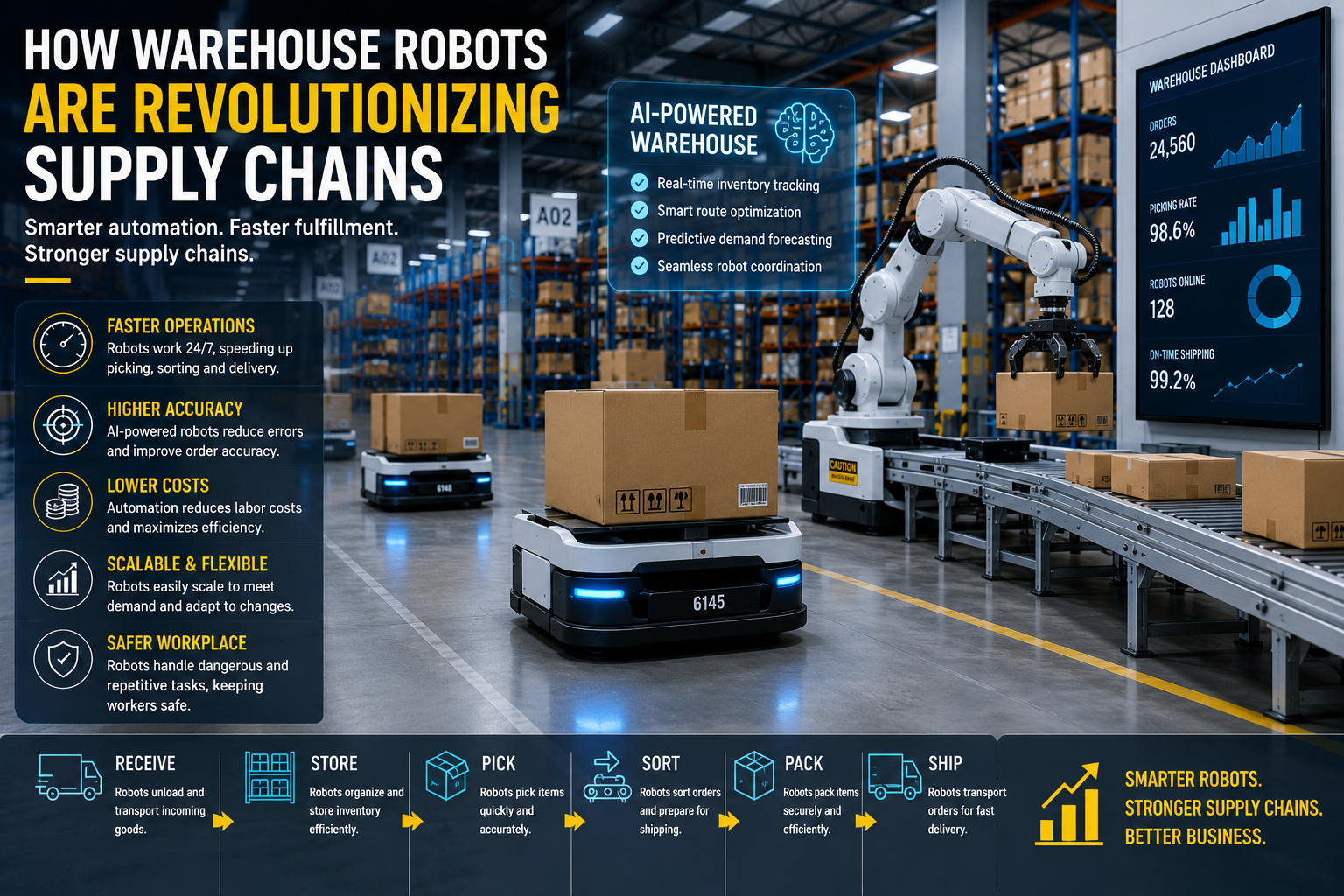
How Warehouse Robots Are Revolutionizing Supply Chains – The global supply chain industry is undergoing a major transformation driven by automation, artificial intelligence (AI), and robotics. As e-commerce continues to grow and customer expectations for faster deliveries increase, businesses are searching for innovative ways to improve efficiency, accuracy, and scalability. One of the most impactful technologies leading this change is the rise of warehouse robots.
Warehouse robots are becoming essential components of modern logistics operations. From moving inventory and picking products to sorting packages and managing stock levels, these intelligent machines are helping organizations streamline operations while reducing costs and improving customer satisfaction.
In 2026, warehouse robotics is no longer a futuristic concept. It has become a strategic investment for companies looking to remain competitive in an increasingly fast-paced global marketplace.
What Are Warehouse Robots?
Warehouse robots are automated machines designed to perform tasks traditionally handled by human workers within warehouses and distribution centers.
Unlike conventional industrial robots that often operate in fixed locations, warehouse robots are highly mobile and adaptable. They can navigate warehouse environments, transport goods, scan inventory, and collaborate with employees.
Common types of warehouse robots include:
- Autonomous Mobile Robots (AMRs)
- Automated Guided Vehicles (AGVs)
- Robotic picking systems
- Sorting robots
- Inventory management robots
- Palletizing robots
- Packaging robots
These systems use advanced technologies such as AI, computer vision, sensors, and machine learning to operate efficiently in dynamic environments.
Why Warehouse Robots Are Growing in Popularity
Several factors are accelerating the adoption of warehouse robotics worldwide.
E-Commerce Expansion
Online shopping continues to grow rapidly, increasing pressure on logistics providers to process and deliver orders faster than ever before.
Warehouse robots help companies handle higher order volumes without proportionally increasing labor costs.
Labor Shortages
Many countries are experiencing shortages of warehouse workers, particularly during peak demand periods.
Robotics provides a solution by automating repetitive and physically demanding tasks.
Rising Customer Expectations
Consumers increasingly expect same-day or next-day delivery.
To meet these expectations, companies need highly efficient fulfillment operations powered by automation.
Advances in Artificial Intelligence
Modern AI technologies enable robots to navigate complex environments, recognize products, optimize routes, and adapt to changing warehouse conditions.
These capabilities have made robotics more practical and cost-effective.
How Warehouse Robots Work
Warehouse robots rely on a combination of hardware and software technologies.
Sensors and Cameras
Robots use cameras, LiDAR, and other sensors to understand their surroundings.
These systems help robots detect obstacles, identify products, and navigate safely.
Artificial Intelligence
AI allows robots to make decisions based on real-time information.
For example, a robot may determine the fastest route to retrieve a product while avoiding congestion in the warehouse.
Machine Learning
Machine learning enables robots to improve performance over time.
By analyzing operational data, robots can optimize workflows and increase efficiency.
Cloud Connectivity
Many warehouse robots are connected through cloud-based platforms that coordinate activities across the entire facility.
Managers can monitor performance and make adjustments in real time.
Key Applications of Warehouse Robots
Warehouse robots are transforming nearly every aspect of logistics operations.
Inventory Transportation
One of the most common uses of warehouse robots is moving inventory throughout a facility.
Autonomous robots transport:
- Products
- Pallets
- Containers
- Materials
This reduces the need for manual transportation and improves workflow efficiency.
Order Picking
Order picking is often one of the most labor-intensive warehouse tasks.
Robotic picking systems use AI and computer vision to locate, identify, and retrieve products accurately.
These systems can significantly increase picking speed while reducing errors.
Sorting Operations
Sorting robots automatically direct products to the correct locations based on shipping requirements.
This improves order accuracy and accelerates fulfillment processes.
Inventory Management
Warehouse robots can continuously scan inventory and update stock records.
This helps organizations maintain accurate inventory levels and reduce stock discrepancies.
Packaging and Palletizing
Robotic systems can package products, stack pallets, and prepare shipments with high levels of precision and consistency.
These capabilities improve productivity while reducing physical strain on workers.
Benefits of Warehouse Robots
The adoption of warehouse robotics offers numerous advantages for businesses.
Increased Efficiency
Robots can operate continuously with minimal downtime.
This enables warehouses to process more orders and improve throughput.
Improved Accuracy
Human errors in picking, sorting, and inventory management can lead to costly mistakes.
Warehouse robots perform tasks with exceptional precision, reducing errors and improving customer satisfaction.
Lower Operating Costs
Although robots require upfront investment, they often generate substantial long-term savings through:
- Reduced labor costs
- Lower error rates
- Increased productivity
- Improved resource utilization
Enhanced Workplace Safety
Warehouses can involve physically demanding and potentially hazardous tasks.
Robots reduce the need for employees to perform repetitive lifting and transportation activities.
This helps create safer working environments.
Scalability
As order volumes grow, organizations can deploy additional robots more easily than recruiting and training large numbers of workers.
This flexibility is particularly valuable during seasonal demand spikes.
Warehouse Robots and E-Commerce
The e-commerce industry has become one of the largest drivers of warehouse automation.
Major online retailers process millions of orders every day.
Warehouse robots help these companies:
- Fulfill orders faster
- Reduce shipping times
- Improve inventory visibility
- Handle peak shopping seasons
- Support same-day delivery services
Without robotics, meeting modern e-commerce expectations would be significantly more challenging.
As online shopping continues to expand, warehouse automation will become even more important.
The Role of AI in Warehouse Robotics
Artificial intelligence is transforming warehouse robots from simple machines into intelligent systems.
AI enables robots to:
- Recognize products
- Optimize routes
- Predict demand patterns
- Manage inventory
- Coordinate with other robots
- Adapt to changing warehouse conditions
Advanced AI systems can analyze vast amounts of operational data and continuously improve warehouse performance.
As AI technology evolves, robots will become increasingly autonomous and capable of handling more complex tasks.
Challenges of Warehouse Robot Adoption
Despite their benefits, warehouse robots present several challenges.
High Initial Costs
Purchasing robots, software platforms, and supporting infrastructure can require significant investment.
Businesses must evaluate long-term return on investment before deployment.
Integration Complexity
Integrating robotic systems with existing warehouse management software can be technically challenging.
Successful implementation often requires careful planning and specialized expertise.
Workforce Adaptation
Employees must learn how to work alongside robots and manage automated systems.
Training and reskilling programs are essential for successful adoption.
Maintenance Requirements
Robotic systems require regular maintenance and software updates to ensure optimal performance.
Organizations must establish effective maintenance strategies to minimize disruptions.
Future Trends in Warehouse Robotics
Several emerging trends are expected to shape the future of warehouse automation.
Autonomous Mobile Robots (AMRs)
AMRs are becoming increasingly sophisticated and capable of navigating warehouses without predefined routes.
AI-Powered Optimization
Advanced AI systems will continue improving warehouse efficiency through predictive analytics and intelligent decision-making.
Human-Robot Collaboration
Collaborative robotics will enable employees and robots to work together more effectively.
Swarm Robotics
Groups of robots may coordinate activities as intelligent fleets, increasing operational flexibility and efficiency.
Fully Automated Warehouses
Future facilities may operate with minimal human intervention, using interconnected robotic systems to manage end-to-end logistics processes.
Conclusion
Warehouse robots are revolutionizing supply chains by transforming how goods are stored, moved, picked, sorted, and shipped. Powered by artificial intelligence, machine learning, and advanced automation technologies, these robots are helping organizations increase efficiency, improve accuracy, reduce costs, and meet growing customer expectations.
From e-commerce fulfillment centers to global distribution hubs, warehouse robotics is becoming a critical component of modern supply chain operations. While challenges related to cost, integration, and workforce adaptation remain, the long-term benefits are driving widespread adoption across industries.
As technology continues to advance, warehouse robots will play an increasingly important role in creating smarter, faster, and more resilient supply chains, shaping the future of logistics for years to come.
Author

96livemarketing@gmail.com
Related Posts
How Digital Twin Robotics Is Improving Real World Automation
- 0
- 1,591 word
How Digital Twin Robotics Is Improving Real World Automation – The rapid advancement of robotics and artificial intelligence is transforming industries around the...
Read out all
Robot Learning and the Next Generation of Intelligent Machines
- 0
- 1,597 word
Robot Learning and the Next Generation of Intelligent Machines – Robotics has evolved dramatically over the past few decades. Early robots were designed...
Read out all
How Surgical Robots Are Transforming Modern Healthcare
- 0
- 1,495 word
How Surgical Robots Are Transforming Modern Healthcare – Healthcare has experienced remarkable technological advancements over the past few decades, and one of...
Read out all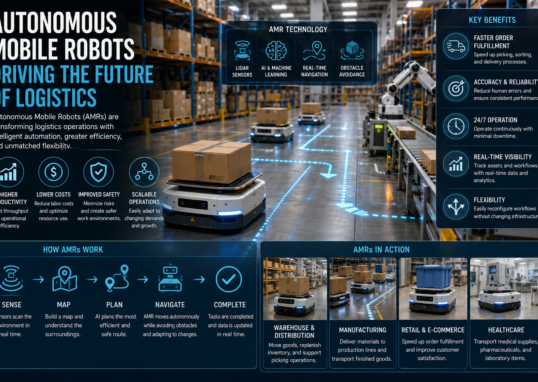
Autonomous Mobile Robots Driving the Future of Logistics
- 0
- 1,458 word
Autonomous Mobile Robots Driving the Future of Logistics – The logistics industry is experiencing a major technological transformation. As global commerce expands and...
Read out all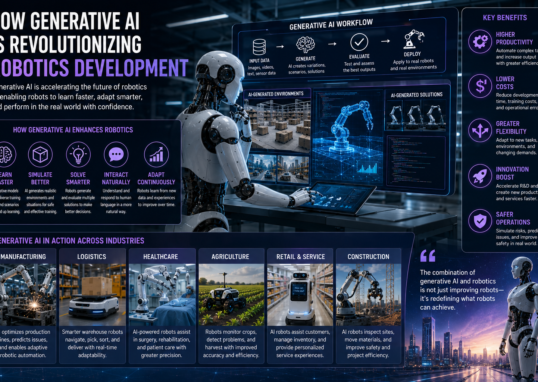
Generative AI for Robotics and the Future of Intelligent Machines
- 0
- 1,425 word
How Generative AI Is Revolutionizing Robotics Development – Artificial intelligence has already transformed countless industries, but one of the most exciting developments...
Read out all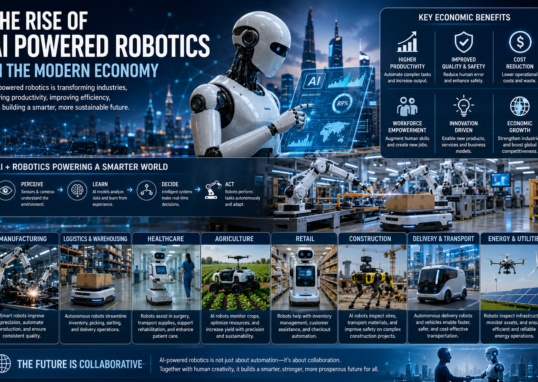
The Rise of AI Powered Robotics in the Modern Economy
- 0
- 1,510 word
The Rise of AI Powered Robotics in the Modern Economy – Artificial intelligence and robotics are two of the most transformative technologies of...
Read out all