
- 0
- 1,309 word
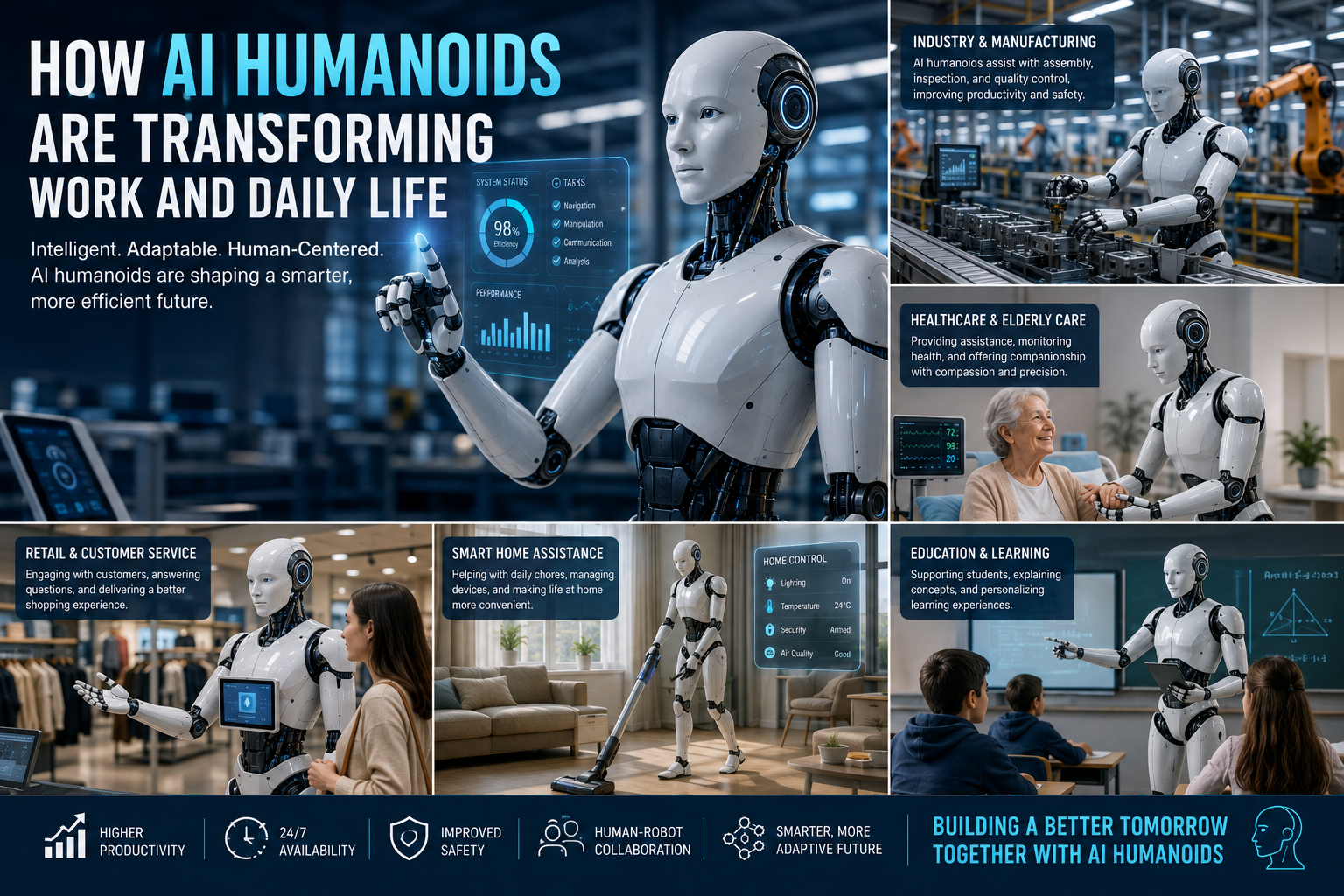
How AI Humanoids Are Transforming Work and Daily Life – Artificial intelligence and robotics are advancing at an unprecedented pace, bringing humanity closer to a future once imagined only in science fiction. Among the most exciting developments is the rise of AI humanoids—human-like robots powered by advanced artificial intelligence that can understand, learn, communicate, and perform a wide range of tasks.
In 2026, AI humanoids are moving beyond research laboratories and technology demonstrations. They are entering workplaces, healthcare facilities, retail stores, warehouses, and even homes. Designed to operate in environments built for humans, these intelligent machines are transforming both work and daily life in ways that could redefine how people interact with technology.
As AI continues to improve, humanoid robots are becoming more capable, adaptable, and useful, opening the door to a new era of human-machine collaboration.
What Are AI Humanoids?
AI humanoids are robots designed to resemble and interact with humans while being powered by artificial intelligence systems.
Unlike traditional industrial robots that are programmed for specific repetitive tasks, AI humanoids can:
- Understand spoken language
- Recognize people and objects
- Navigate complex environments
- Learn from experience
- Make decisions in real time
- Perform multiple tasks
Their human-like form allows them to operate in spaces designed for people, such as offices, homes, hospitals, and public buildings.
Modern AI humanoids combine several advanced technologies, including:
- Artificial Intelligence
- Machine Learning
- Computer Vision
- Natural Language Processing
- Sensor Fusion
- Robotics Engineering
Together, these technologies enable robots to interact naturally with humans and adapt to changing situations.
Why AI Humanoids Are Gaining Attention
Several factors are driving increased interest in AI humanoids.
Advances in Artificial Intelligence
Recent breakthroughs in large language models, multimodal AI, and machine learning have significantly improved robot intelligence.
Humanoids can now understand context, communicate naturally, and perform increasingly sophisticated tasks.
Labor Shortages
Many industries face workforce shortages, especially in manufacturing, logistics, healthcare, and customer service.
AI humanoids offer a potential solution by handling routine or physically demanding tasks.
Flexible Deployment
Unlike specialized automation systems, humanoid robots can perform multiple roles in different environments.
This flexibility makes them attractive investments for businesses seeking adaptable automation solutions.
Falling Technology Costs
As hardware and AI technologies mature, the cost of developing and deploying humanoid robots continues to decline.
This is making adoption more practical across a broader range of industries.
How AI Humanoids Are Transforming Work
The workplace is one of the areas experiencing the greatest impact from humanoid robotics.
Manufacturing and Production
Factories are increasingly adopting AI humanoids to assist with:
- Assembly operations
- Material handling
- Equipment inspections
- Quality control
- Packaging tasks
Because humanoids can move through spaces designed for human workers, they can integrate into existing facilities without major infrastructure changes.
Their ability to work continuously also helps improve productivity and reduce operational costs.
Warehousing and Logistics
The rapid growth of e-commerce has increased demand for efficient logistics operations.
AI humanoids can support warehouse activities by:
- Picking and packing orders
- Transporting inventory
- Managing stock levels
- Performing inspections
These capabilities help companies improve speed, accuracy, and scalability.
Customer Service
Many businesses are exploring AI humanoids as customer-facing assistants.
In retail environments, robots can:
- Greet customers
- Answer questions
- Provide directions
- Recommend products
- Process simple transactions
Their ability to communicate naturally creates a more engaging customer experience.
Hospitality and Tourism
Hotels, airports, and tourism businesses are beginning to use humanoid robots for guest services.
Applications include:
- Reception assistance
- Concierge services
- Check-in support
- Multilingual communication
- Travel information
Humanoids can operate around the clock, helping organizations improve service availability and efficiency.
Office and Administrative Support
Future workplaces may include humanoid assistants that help with:
- Scheduling
- Document management
- Meeting coordination
- Data entry
- Information retrieval
By automating routine administrative work, employees can focus on higher-value activities.
The Impact of AI Humanoids on Daily Life
Beyond the workplace, AI humanoids are increasingly influencing everyday life.
Smart Home Assistance
Humanoid robots are becoming more capable household assistants.
Potential home applications include:
- Cleaning
- Organizing spaces
- Managing smart home devices
- Delivering reminders
- Providing information
As AI improves, these robots may become valuable companions for busy households.
Elderly Care
Aging populations are creating growing demand for caregiving solutions.
AI humanoids can support older adults by:
- Monitoring health conditions
- Assisting with daily activities
- Providing companionship
- Offering medication reminders
- Contacting emergency services when needed
These capabilities may help seniors maintain independence for longer periods.
Education and Learning
Humanoid robots are finding roles in education as interactive learning assistants.
They can:
- Tutor students
- Explain concepts
- Answer questions
- Support language learning
- Personalize educational experiences
Their engaging nature can help improve student participation and motivation.
Personal Companionship
Advances in conversational AI are enabling humanoid robots to provide increasingly natural interactions.
While they cannot replace human relationships, some people may benefit from robotic companions that offer conversation, entertainment, and assistance.
The Role of AI in Humanoid Robotics
Artificial intelligence is what transforms a robot from a machine into an intelligent assistant.
Modern AI humanoids rely on several key AI technologies.
Natural Language Processing
This enables robots to understand and generate human language.
Users can communicate naturally through voice commands and conversations.
Computer Vision
Computer vision allows robots to identify:
- People
- Objects
- Locations
- Facial expressions
- Environmental hazards
This capability helps robots interact safely and effectively with their surroundings.
Machine Learning
Machine learning enables robots to improve performance over time.
By learning from interactions and experiences, humanoids can adapt to user preferences and changing environments.
Multimodal AI
Modern humanoids increasingly use multimodal AI to combine information from:
- Text
- Images
- Audio
- Video
- Sensors
This creates a more comprehensive understanding of the world and supports more intelligent decision-making.
Benefits of AI Humanoids
The growing adoption of AI humanoids is driven by several significant benefits.
Increased Productivity
Humanoids can perform repetitive tasks consistently and efficiently.
This allows businesses to improve productivity while reducing manual workloads.
Enhanced Service Availability
Unlike humans, robots can operate continuously without fatigue.
This makes them valuable for industries requiring 24/7 support.
Improved Safety
Humanoids can handle dangerous tasks in hazardous environments, reducing risks for human workers.
Greater Accessibility
AI-powered assistants can help people with disabilities by providing physical and digital support.
Workforce Support
Rather than replacing employees entirely, many organizations view humanoids as tools that augment human capabilities.
Challenges and Concerns
Despite their potential, AI humanoids face several challenges.
High Costs
Developing advanced humanoid robots remains expensive.
Although costs are decreasing, affordability remains a barrier for widespread adoption.
Technical Limitations
Humanoids still struggle with some tasks that humans perform naturally, particularly in unpredictable environments.
Privacy Issues
Robots often rely on cameras, microphones, and sensors.
Organizations must ensure responsible handling of personal data and privacy protection.
Ethical Considerations
Questions surrounding employment, decision-making authority, and human-robot relationships continue to generate debate.
Governments and businesses must establish clear guidelines for responsible deployment.
The Future of AI Humanoids
The future of AI humanoids appears increasingly promising.
Several trends are expected to accelerate development:
- More advanced AI reasoning capabilities
- Improved mobility and dexterity
- Longer battery life
- Lower production costs
- Enhanced human-robot collaboration
- Integration with smart homes and workplaces
Many experts believe humanoid robots will become common in both professional and personal environments over the next decade.
Rather than replacing humans entirely, they are likely to function as intelligent assistants that complement human skills and improve productivity.
Conclusion
AI humanoids are transforming work and daily life by bringing advanced intelligence into human-centered environments. From factories and warehouses to hospitals, schools, offices, and homes, these robots are becoming increasingly capable of performing useful tasks and supporting human activities.
Powered by breakthroughs in artificial intelligence, computer vision, machine learning, and robotics, AI humanoids are moving from experimental prototypes to practical tools. While challenges related to cost, privacy, and ethics remain, the potential benefits are driving rapid innovation and adoption.
As technology continues to evolve, AI humanoids may become one of the most influential developments of the modern era, reshaping industries, enhancing productivity, and changing how people interact with machines in everyday life.
Author

96livemarketing@gmail.com
Related Posts

F1 Singapore Grand Prix: Max Verstappen wins at Marina Bay Street Circuit for first time – Yahoo Sports
- 0
- 2,469 words
⏱11 min readOn this pageWhat You’ll NeedSteps to AppreciationStep 1: Understand the Marina Bay Street Circuit’s Unique ChallengeStep 2: Grasp the Significance...
Read out all
Petronas boosts payments to Malaysia as oil prices surge – Free Malaysia Today
- 0
- 2,191 words
⏱10 min readOn this pageWhat you’ll needSteps1. Start with the Fundamentals: Who is Petronas and What Do They Do?2. Deciphering the Payment...
Read out all
Former HK actor Liu Wai Hung says he left TVB over long-term financial security – The Star
- 0
- 2,447 words
⏱11 min readOn this pageWhat You’ll NeedStepsStep 1: Conduct a Comprehensive Financial AuditStep 2: Define Your Vision for Financial SecurityStep 3: Master...
Read out allPavé the way – theedgemalaysia.com
- 0
- 2,835 words
⏱13 min readOn this pageWhat You’ll NeedTools:Materials:StepsPlan Your Project and Design Your SpacePrepare the Site: ExcavationInstall Geotextile FabricLay the Base MaterialInstall Edge...
Read out all
England thrash Croatia to put World Cup heartbreak firmly behind them – ESPN
- 0
- 2,537 words
⏱12 min readOn this pageWhat You’ll NeedSteps1. Understand the Weight of Past Disappointment2. Grasp the Pre-Match Narrative and Stakes3. Identify the Tactical...
Read out all
Many docs quit after postings – The Star
- 0
- 2,144 words
⏱9 min readOn this pageWhat You’ll NeedSteps1. Understand the Root Causes Through Data and Dialogue2. Enhance Early Career Support and Mentorship Programs3....
Read out all