
- 0
- 1,425 word
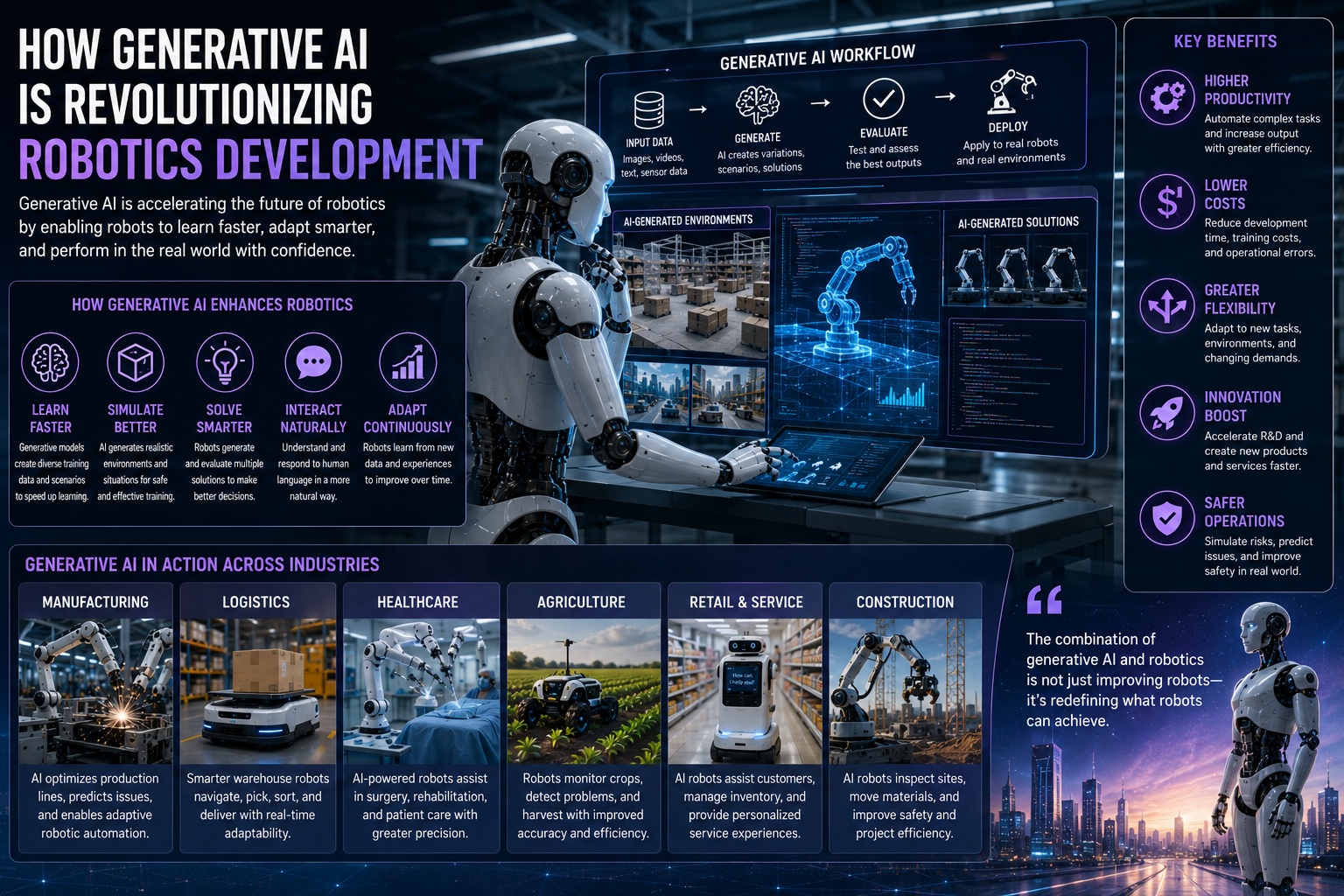
How Generative AI Is Revolutionizing Robotics Development – Artificial intelligence has already transformed countless industries, but one of the most exciting developments in recent years is the convergence of generative AI and robotics. While robots have traditionally relied on predefined programming and structured environments, generative AI is enabling machines to become more adaptable, intelligent, and capable of handling complex real-world situations.
Generative AI, which powers technologies such as advanced language models, image generators, and multimodal systems, is now being integrated into robotic platforms to improve learning, decision-making, simulation, and human-robot interaction. This combination is accelerating robotics development at a pace that was difficult to imagine only a few years ago.
In 2026, technology companies, research institutions, and robotics startups are investing heavily in generative AI-powered robotics. The result is a new generation of machines that can learn faster, adapt more effectively, and perform a broader range of tasks across industries.
What Is Generative AI?
Generative AI refers to artificial intelligence systems capable of creating new content, solutions, or data based on patterns learned from existing information.
Unlike traditional AI systems that primarily classify or analyze data, generative AI can produce:
- Text
- Images
- Videos
- Audio
- Software code
- Simulations
- Predictions
Large language models and multimodal AI systems are among the most widely known examples of generative AI.
These systems can understand context, generate responses, and solve problems in increasingly sophisticated ways.
Why Robotics Needs Generative AI
Traditional robots perform exceptionally well in controlled environments where tasks are repetitive and predictable.
However, the real world is far more complex.
Robots operating in homes, hospitals, warehouses, factories, and public spaces must deal with:
- Unpredictable situations
- Dynamic environments
- Human interactions
- New objects and obstacles
- Changing objectives
Generative AI helps robots overcome these challenges by enabling greater flexibility and adaptability.
Rather than relying solely on fixed programming, robots can generate solutions and responses in real time.
Accelerating Robot Learning
One of the most important contributions of generative AI is its ability to speed up robot learning.
Learning From Massive Data Sets
Generative AI models can be trained on enormous amounts of information gathered from:
- Videos
- Images
- Text
- Simulations
- Sensor data
This allows robots to develop a broader understanding of the world before entering real environments.
Reducing Training Time
Traditionally, robot training required extensive manual programming and real-world testing.
Generative AI dramatically reduces this effort by enabling robots to learn from virtual experiences and synthetic data.
As a result, development cycles become faster and more cost-effective.
Generalizing Skills
Instead of learning a single task, robots can develop broader skills that apply across multiple situations.
This improves versatility and adaptability.
Enhancing Robot Simulation
Simulation plays a critical role in modern robotics development.
Generative AI is making simulations more realistic and useful.
Creating Virtual Environments
Generative models can automatically generate detailed virtual worlds for robot training.
These environments may include:
- Buildings
- Streets
- Factories
- Warehouses
- Homes
Robots can practice tasks safely before operating in the real world.
Sim-to-Real Transfer
One challenge in robotics is transferring skills learned in simulation to real environments.
Generative AI helps create simulations that closely resemble reality, improving the success of sim-to-real training.
This reduces deployment risks and development costs.
Improving Human Robot Interaction
As robots become more common in workplaces and homes, communication between humans and machines becomes increasingly important.
Natural Language Understanding
Large language models allow robots to understand conversational instructions.
Users can communicate with robots using everyday language rather than specialized commands.
For example, instead of programming a sequence of actions, a user might simply say:
“Organize the packages on that shelf and bring me the largest box.”
The robot can interpret the request and determine how to complete the task.
Context Awareness
Generative AI helps robots understand context and intent.
This enables more natural and effective interactions with people.
Personalized Assistance
Robots can learn individual preferences and adapt their behavior accordingly.
This creates more personalized user experiences.
Supporting Autonomous Decision Making
Autonomous robots must constantly make decisions while operating in dynamic environments.
Generative AI improves decision-making capabilities by enabling robots to evaluate multiple options and predict outcomes.
Scenario Planning
Generative AI can simulate different actions and estimate potential consequences.
This allows robots to choose more effective solutions.
Problem Solving
When encountering unfamiliar situations, robots can generate potential responses rather than relying solely on predefined rules.
This increases adaptability and resilience.
Continuous Learning
Robots can refine decision-making processes through ongoing experience and feedback.
Generative AI in Manufacturing Robotics
Manufacturing is one of the largest adopters of advanced robotics.
Generative AI is helping manufacturers create smarter automation systems.
Production Optimization
AI-powered robots can analyze production data and recommend improvements to workflows.
Quality Control
Generative AI enhances visual inspection systems by identifying defects and anomalies more accurately.
Flexible Manufacturing
Robots become capable of adapting to new products and production requirements with minimal reprogramming.
This increases manufacturing agility and efficiency.
Transforming Logistics and Warehousing
Logistics companies are increasingly using generative AI to improve robotic operations.
Smarter Warehouse Robots
Warehouse robots can optimize routes, prioritize tasks, and adapt to changing conditions.
Inventory Management
Generative AI helps robots predict inventory needs and improve stock management.
Autonomous Coordination
Multiple robots can coordinate activities more effectively using AI-driven planning and communication.
This enhances warehouse productivity and order fulfillment.
Healthcare Robotics and Generative AI
Healthcare represents another major area of innovation.
Medical Assistance
Generative AI helps healthcare robots understand patient requests and communicate more naturally.
Surgical Support
Advanced robotic systems can assist surgeons with planning and precision during procedures.
Rehabilitation Robotics
AI-powered rehabilitation robots adapt therapy programs based on patient progress and needs.
Elderly Care
Robots can provide personalized assistance and companionship for older adults while supporting independent living.
Generative AI and Humanoid Robots
Humanoid robots are among the most visible examples of the future of robotics.
Generative AI is accelerating their development by improving:
- Language capabilities
- Reasoning abilities
- Planning skills
- Object recognition
- Human interaction
These advancements allow humanoid robots to perform a wider range of tasks in environments designed for people.
As a result, humanoid robots are becoming increasingly practical for real-world applications.
Economic Impact of Generative AI Robotics
The combination of generative AI and robotics has significant economic implications.
Increased Productivity
Organizations can automate more complex processes than ever before.
Faster Innovation
Generative AI shortens development timelines and reduces engineering costs.
New Business Opportunities
Companies can create new products, services, and business models based on intelligent robotic systems.
Workforce Transformation
Rather than simply replacing workers, many AI-powered robots will collaborate with humans and augment their capabilities.
This creates opportunities for new roles focused on managing and working alongside intelligent machines.
Challenges Facing Generative AI Robotics
Despite its promise, generative AI robotics faces several challenges.
Reliability
Robots must consistently make accurate decisions in real-world environments.
Errors can have significant consequences.
Safety
Physical robots interacting with people require rigorous safety measures.
Data Quality
Generative AI systems depend on high-quality training data.
Poor data can lead to inaccurate outputs and unreliable behavior.
Ethical Considerations
Organizations must address concerns related to privacy, accountability, transparency, and employment impacts.
Computing Requirements
Advanced AI models often require significant computing resources and energy consumption.
Developers continue working to improve efficiency.
Future Trends in Generative AI Robotics
Several trends are expected to shape the future of this field.
Embodied AI
Embodied AI combines advanced intelligence with physical robotic systems capable of learning through real-world interaction.
Robot Foundation Models
Large-scale AI models trained on diverse robotic experiences will support broader capabilities across many tasks.
Agentic Robotics
Future robots will possess stronger planning and goal-oriented reasoning abilities.
General Purpose Robots
Robots will become capable of handling multiple tasks instead of specializing in a single activity.
Human Robot Collaboration
More sophisticated communication and collaboration capabilities will strengthen partnerships between humans and robots.
Conclusion
Generative AI is revolutionizing robotics development by enabling machines to learn faster, adapt more effectively, and operate more intelligently in real-world environments. Through advances in simulation, decision-making, natural language understanding, and autonomous learning, generative AI is helping create a new generation of robots capable of performing increasingly complex tasks.
From manufacturing and logistics to healthcare and service industries, organizations are leveraging generative AI-powered robotics to improve productivity, innovation, and operational efficiency. While challenges related to safety, reliability, ethics, and computing requirements remain, the benefits of this technological convergence are driving rapid adoption across the global economy.
As generative AI continues to evolve, its integration with robotics will play a central role in shaping the future of automation, intelligent machines, and human-robot collaboration. The coming decade may see robots become more capable, versatile, and useful than ever before, fundamentally changing how people live and work.
Author

96livemarketing@gmail.com
Related Posts
How Digital Twin Robotics Is Improving Real World Automation
- 0
- 1,591 word
How Digital Twin Robotics Is Improving Real World Automation – The rapid advancement of robotics and artificial intelligence is transforming industries around the...
Read out all
Robot Learning and the Next Generation of Intelligent Machines
- 0
- 1,597 word
Robot Learning and the Next Generation of Intelligent Machines – Robotics has evolved dramatically over the past few decades. Early robots were designed...
Read out all
How Surgical Robots Are Transforming Modern Healthcare
- 0
- 1,495 word
How Surgical Robots Are Transforming Modern Healthcare – Healthcare has experienced remarkable technological advancements over the past few decades, and one of...
Read out all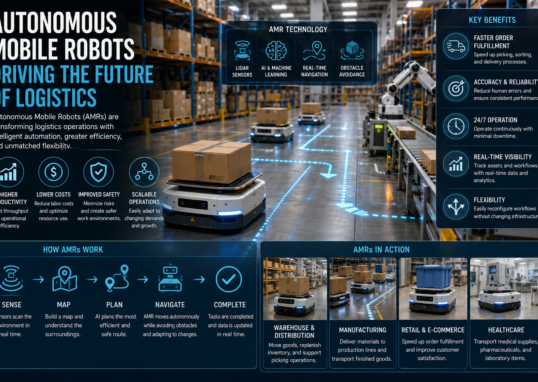
Autonomous Mobile Robots Driving the Future of Logistics
- 0
- 1,458 word
Autonomous Mobile Robots Driving the Future of Logistics – The logistics industry is experiencing a major technological transformation. As global commerce expands and...
Read out all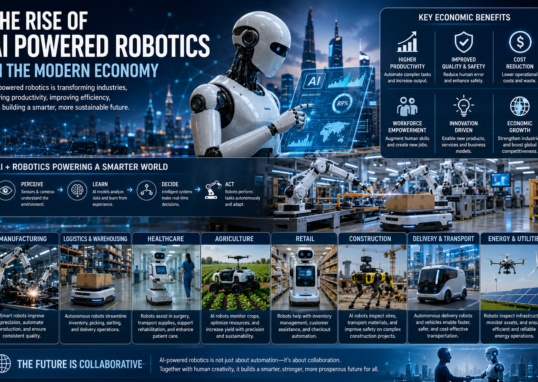
The Rise of AI Powered Robotics in the Modern Economy
- 0
- 1,510 word
The Rise of AI Powered Robotics in the Modern Economy – Artificial intelligence and robotics are two of the most transformative technologies of...
Read out all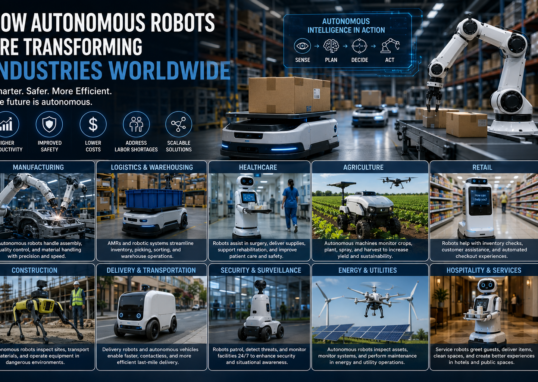
How Autonomous Robots Are Transforming Industries Worldwide
- 0
- 1,304 word
How Autonomous Robots Are Transforming Industries Worldwide – Autonomous robots are rapidly becoming one of the most influential technologies of the modern era....
Read out all