
- 0
- 1,495 word
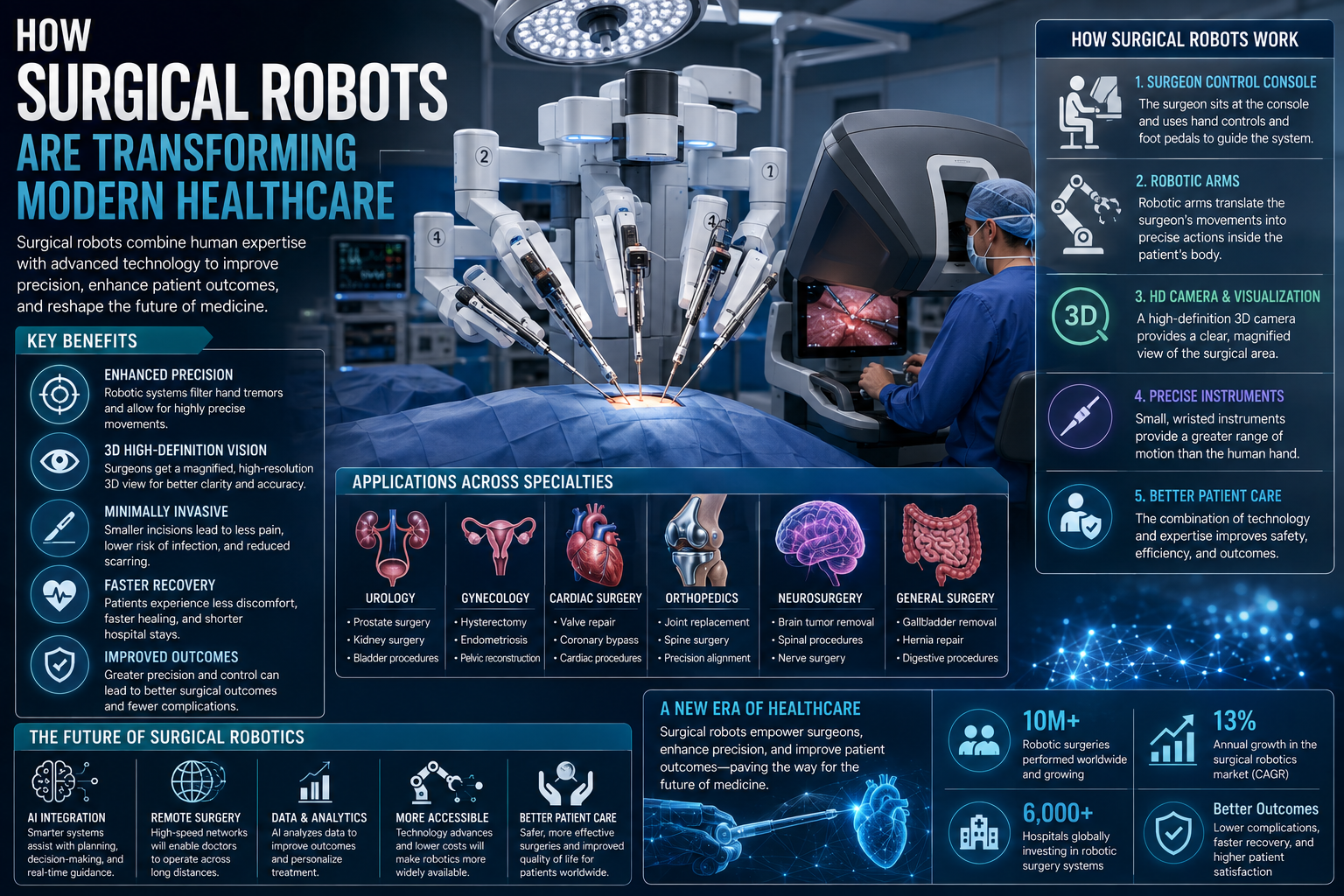
How Surgical Robots Are Transforming Modern Healthcare – Healthcare has experienced remarkable technological advancements over the past few decades, and one of the most significant innovations is the rise of surgical robots. These advanced robotic systems are changing how medical procedures are performed, helping surgeons achieve greater precision, control, and efficiency while improving outcomes for patients.
Once considered futuristic technology, robotic-assisted surgery has become a vital part of modern healthcare. Hospitals and medical centers worldwide are increasingly adopting surgical robots for a wide range of procedures, including cardiac surgery, urology, orthopedics, gynecology, neurosurgery, and general surgery. As artificial intelligence, imaging technologies, and robotic engineering continue to evolve, surgical robots are becoming more capable and accessible.
In 2026, surgical robotics represents one of the fastest-growing sectors in healthcare technology. The combination of robotics, AI, advanced visualization, and minimally invasive techniques is helping redefine patient care and shaping the future of medicine.
What Are Surgical Robots?
Surgical robots are computer-assisted robotic systems designed to help surgeons perform medical procedures with enhanced precision and control.
Despite the term “robotic surgery,” these systems do not operate independently. Instead, surgeons remain in full control of the robotic instruments throughout the procedure.
A typical robotic surgery system includes:
- A surgeon control console
- Robotic arms
- Specialized surgical instruments
- High-definition cameras
- Advanced imaging systems
- Computerized control software
The surgeon uses the console to guide the robotic arms, which translate hand movements into highly precise actions inside the patient’s body.
This combination of human expertise and robotic precision creates significant advantages over traditional surgical approaches.
The Evolution of Robotic Surgery
The development of surgical robotics began decades ago with the goal of improving surgical accuracy and reducing invasiveness.
Early Innovations
Initial robotic systems focused on assisting surgeons with precise movements during specialized procedures.
These early systems demonstrated the potential for robotics to improve surgical performance.
Expansion Across Medical Specialties
As technology improved, robotic-assisted surgery expanded into multiple fields including:
- Urology
- Gynecology
- Cardiac surgery
- Orthopedic surgery
- General surgery
Hospitals increasingly recognized the benefits of robotic-assisted procedures.
Integration of Artificial Intelligence
Recent advancements have introduced AI-powered capabilities that support planning, visualization, and surgical decision-making.
These innovations continue expanding the capabilities of modern surgical robots.
Why Surgical Robots Are Growing in Popularity
Several factors are driving the widespread adoption of robotic-assisted surgery.
Increasing Demand for Minimally Invasive Procedures
Patients increasingly prefer minimally invasive surgery due to:
- Smaller incisions
- Reduced pain
- Faster recovery
- Lower infection risks
- Shorter hospital stays
Robotic systems support these goals by enabling highly precise surgical techniques.
Improved Surgical Outcomes
Robotic-assisted procedures often provide enhanced precision compared to traditional methods.
This can lead to improved patient outcomes and reduced complications.
Advances in Technology
Improvements in imaging, computing power, robotics, and artificial intelligence continue expanding the capabilities of surgical systems.
Growing Healthcare Investments
Hospitals and healthcare organizations are investing heavily in advanced technologies to improve patient care and remain competitive.
Enhanced Precision and Accuracy
One of the most important benefits of surgical robots is their ability to improve surgical precision.
Motion Scaling
Robotic systems can translate large hand movements into tiny, highly controlled instrument movements.
This allows surgeons to perform delicate procedures with exceptional accuracy.
Tremor Reduction
Even highly skilled surgeons naturally experience small hand tremors.
Robotic systems filter these movements, resulting in greater stability.
Access to Difficult Areas
Robotic instruments can reach areas of the body that may be difficult to access using conventional techniques.
This capability expands treatment options for complex conditions.
Advanced Visualization Capabilities
Modern surgical robots provide surgeons with enhanced views of the surgical field.
High-Definition Imaging
Advanced cameras deliver detailed images that improve visibility during procedures.
Three-Dimensional Visualization
Many systems provide 3D imaging, offering greater depth perception and spatial awareness.
Magnification
Robotic platforms often provide magnified views of tissues and structures.
This helps surgeons identify critical anatomical details more clearly.
Enhanced visualization contributes significantly to surgical accuracy and patient safety.
Benefits for Patients
The growing popularity of robotic-assisted surgery is largely driven by patient benefits.
Smaller Incisions
Robotic systems support minimally invasive techniques that require smaller surgical openings.
Reduced Blood Loss
Greater precision often results in less tissue damage and reduced bleeding.
Lower Risk of Infection
Smaller incisions can decrease the likelihood of postoperative infections.
Faster Recovery Times
Many patients recover more quickly after robotic-assisted procedures.
Shorter Hospital Stays
Improved recovery often allows patients to return home sooner.
Less Pain and Scarring
Minimally invasive procedures generally produce less discomfort and reduced scarring.
These advantages contribute to higher patient satisfaction and improved quality of care.
Surgical Robots in Different Medical Specialties
Robotic-assisted surgery is now used across numerous medical fields.
Urology
Urology remains one of the most common applications for surgical robots.
Procedures include:
- Prostate surgery
- Kidney surgery
- Bladder surgery
Robotic systems help improve precision while preserving critical structures.
Gynecology
Robotic-assisted techniques are frequently used for:
- Hysterectomies
- Endometriosis treatment
- Pelvic reconstruction
These procedures often benefit from improved visualization and precision.
Cardiac Surgery
Heart surgery requires exceptional accuracy.
Robotic systems assist with procedures involving:
- Valve repair
- Coronary artery bypass
- Cardiac tissue interventions
Orthopedic Surgery
Orthopedic robots help surgeons perform joint replacement procedures with greater precision.
This may improve implant positioning and long-term outcomes.
Neurosurgery
Robotic technologies assist with highly delicate procedures involving the brain and nervous system.
General Surgery
Many abdominal and gastrointestinal procedures now utilize robotic-assisted techniques.
The Role of Artificial Intelligence in Surgical Robotics
Artificial intelligence is becoming increasingly important in robotic surgery.
Surgical Planning
AI analyzes medical imaging data to assist surgeons with preoperative planning.
Real-Time Guidance
Advanced algorithms provide support during procedures by identifying anatomical structures and potential risks.
Predictive Analytics
AI can help predict complications and improve surgical decision-making.
Workflow Optimization
Machine learning systems assist hospitals in improving operating room efficiency.
Although surgeons remain in control, AI increasingly serves as a valuable decision-support tool.
Remote Surgery and Telemedicine
One of the most exciting possibilities for surgical robotics is remote surgery.
Expanding Access to Care
Robotic systems may enable highly skilled surgeons to assist patients in remote locations.
Telemedicine Integration
Advances in connectivity support collaboration between medical professionals across geographic boundaries.
Disaster and Military Applications
Remote surgical capabilities may prove valuable in emergency situations and challenging environments.
While widespread remote surgery still faces technical and regulatory challenges, ongoing innovation continues to move the field forward.
Economic Impact of Surgical Robotics
The growth of robotic surgery is creating significant economic effects throughout the healthcare sector.
Healthcare Technology Investment
Hospitals continue investing in robotic systems to improve patient outcomes and attract patients.
Industry Growth
The surgical robotics market is expanding rapidly as demand increases worldwide.
Job Creation
Growth in the industry supports careers in:
- Robotics engineering
- Medical technology
- Software development
- Healthcare training
- Technical support
Long-Term Cost Savings
Although robotic systems require substantial upfront investment, improved outcomes and shorter hospital stays may reduce overall healthcare costs.
Challenges Facing Surgical Robotics
Despite its advantages, surgical robotics faces several challenges.
High Costs
Purchasing and maintaining robotic systems can be expensive.
This remains a barrier for some healthcare facilities.
Training Requirements
Surgeons require specialized training to operate robotic systems effectively.
Technical Complexity
Advanced robotic platforms involve sophisticated hardware and software components.
Regular maintenance and technical support are essential.
Accessibility Concerns
Not all hospitals have access to robotic surgery technology.
Expanding availability remains an ongoing challenge.
Regulatory Oversight
Healthcare authorities continue developing standards to ensure safety and effectiveness.
Future Trends in Surgical Robotics
The future of robotic surgery is expected to be shaped by several key trends.
More Advanced AI Integration
Artificial intelligence will continue enhancing planning, visualization, and decision support capabilities.
Smaller and More Flexible Robots
Future systems may become more compact and versatile.
Greater Automation
Certain routine tasks may become increasingly automated under surgeon supervision.
Enhanced Imaging Technologies
Improved imaging will provide even greater visibility and precision.
Expanded Procedure Availability
Robotic-assisted techniques will likely become available for a broader range of medical conditions.
Increased Global Adoption
As costs decrease and technology matures, more healthcare providers will adopt robotic systems.
Surgical Robots and Personalized Medicine
Robotic technologies are contributing to the broader movement toward personalized healthcare.
Advanced data analysis allows surgeons to tailor procedures based on:
- Patient anatomy
- Medical history
- Disease characteristics
- Individual treatment goals
This personalized approach may further improve outcomes and patient satisfaction.
Conclusion
Surgical robots are transforming modern healthcare by combining the expertise of surgeons with the precision, stability, and advanced capabilities of robotic technology. Through enhanced visualization, minimally invasive techniques, artificial intelligence, and improved accuracy, robotic-assisted surgery is helping improve patient outcomes across numerous medical specialties.
From urology and cardiology to orthopedics and neurosurgery, surgical robots are becoming an increasingly important part of healthcare systems worldwide. While challenges related to cost, training, accessibility, and regulation remain, ongoing technological advancements continue to expand the potential of robotic surgery.
As artificial intelligence, imaging technologies, and robotic engineering evolve, surgical robots will play an even greater role in the future of medicine. Their ability to improve safety, precision, efficiency, and patient care makes them one of the most impactful innovations shaping modern healthcare today.
Author

96livemarketing@gmail.com
Related Posts

How Digital Twin Robotics Is Improving Real World Automation
- 0
- 1,591 word
How Digital Twin Robotics Is Improving Real World Automation – The rapid advancement of robotics and artificial intelligence is transforming industries around the...
Read out all
Robot Learning and the Next Generation of Intelligent Machines
- 0
- 1,597 word
Robot Learning and the Next Generation of Intelligent Machines – Robotics has evolved dramatically over the past few decades. Early robots were designed...
Read out all
Autonomous Mobile Robots Driving the Future of Logistics
- 0
- 1,458 word
Autonomous Mobile Robots Driving the Future of Logistics – The logistics industry is experiencing a major technological transformation. As global commerce expands and...
Read out all
Generative AI for Robotics and the Future of Intelligent Machines
- 0
- 1,425 word
How Generative AI Is Revolutionizing Robotics Development – Artificial intelligence has already transformed countless industries, but one of the most exciting developments...
Read out all
The Rise of AI Powered Robotics in the Modern Economy
- 0
- 1,510 word
The Rise of AI Powered Robotics in the Modern Economy – Artificial intelligence and robotics are two of the most transformative technologies of...
Read out all
How Autonomous Robots Are Transforming Industries Worldwide
- 0
- 1,304 word
How Autonomous Robots Are Transforming Industries Worldwide – Autonomous robots are rapidly becoming one of the most influential technologies of the modern era....
Read out all