- 0
- 1,597 word
Robot Learning and the Next Generation of Intelligent Machines – Robotics has evolved dramatically over the past few decades. Early robots were designed to perform repetitive tasks in highly controlled environments, following pre-programmed instructions with little flexibility. While these machines revolutionized manufacturing and automation, they lacked the ability to adapt to new situations or learn from experience.
Today, a new era of robotics is emerging, powered by advances in artificial intelligence, machine learning, computer vision, and large-scale data processing. At the center of this transformation is Robot Learning, a field focused on enabling robots to acquire new skills, improve performance, and make decisions through experience rather than relying solely on explicit programming.
Robot learning is becoming one of the most important technologies shaping the future of intelligent machines. From warehouse automation and autonomous vehicles to healthcare robots and humanoid assistants, learning-enabled robots are expanding the capabilities of automation across nearly every industry.
As AI technologies continue advancing, robot learning is paving the way for machines that can understand their environments, interact naturally with humans, and perform increasingly complex tasks. In 2026 and beyond, robot learning is expected to become a foundational technology behind the next generation of intelligent machines.
What Is Robot Learning?
Robot learning refers to the use of machine learning techniques that allow robots to improve their performance through experience, data, and interaction with their environment.
Instead of relying entirely on fixed programming, learning robots can:
- Adapt to changing environments
- Learn new tasks
- Improve decision-making
- Recognize patterns
- Optimize behaviors
- Respond to unexpected situations
Robot learning combines robotics with artificial intelligence to create systems capable of continuous improvement.
The goal is to develop robots that can function more like humans, learning from experience rather than following rigid instructions.
Why Robot Learning Matters
Traditional robots are highly effective in structured environments where tasks remain consistent.
However, many real-world situations involve:
- Uncertainty
- Dynamic conditions
- Unpredictable obstacles
- Human interaction
- Complex decision-making
Programming robots for every possible scenario is often impossible.
Robot learning addresses this challenge by enabling machines to develop their own understanding of tasks and environments.
This flexibility makes robots more useful across a wider range of applications.
As industries seek greater automation and efficiency, robot learning is becoming increasingly important.
The Evolution of Intelligent Robotics
The journey toward intelligent robots has occurred in several stages.
Rule-Based Automation
Early robots followed predefined instructions.
Every action required explicit programming.
These systems worked well for repetitive manufacturing tasks but lacked adaptability.
Sensor-Based Robotics
Robots began incorporating sensors to monitor their surroundings.
This improved awareness and allowed limited responses to environmental changes.
AI-Assisted Robotics
Artificial intelligence introduced capabilities such as:
- Object recognition
- Path planning
- Decision support
- Predictive analysis
These advances significantly expanded robotic functionality.
Learning-Based Robotics
Modern robots can now learn from data and experience.
This shift is transforming robots from automated tools into intelligent systems capable of continuous improvement.
Core Technologies Behind Robot Learning
Several technologies enable robot learning.
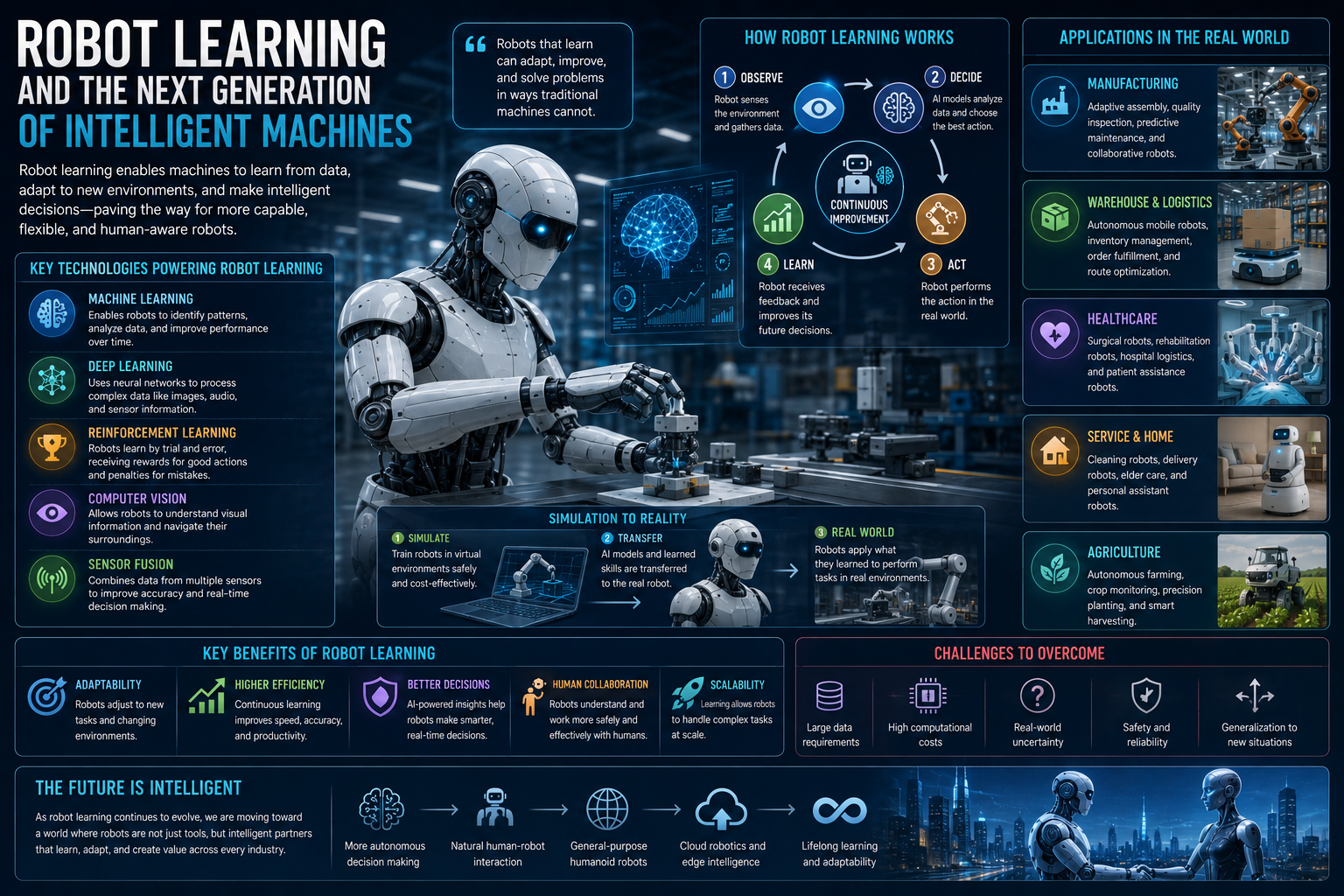
Machine Learning
Machine learning algorithms allow robots to identify patterns and improve performance through data analysis.
The more data a robot processes, the better it can perform certain tasks.
Deep Learning
Deep learning uses neural networks with multiple layers to process complex information.
This technology powers capabilities such as:
- Computer vision
- Speech recognition
- Object detection
- Natural language understanding
Reinforcement Learning
Reinforcement learning is one of the most important approaches in robot learning.
Robots learn by:
- Taking actions
- Receiving feedback
- Maximizing rewards
- Minimizing mistakes
Over time, the robot discovers the most effective strategies.
Computer Vision
Computer vision allows robots to understand visual information.
This includes:
- Recognizing objects
- Identifying people
- Understanding environments
- Navigating spaces
Visual learning is critical for intelligent robotic behavior.
How Robots Learn From Experience
Human learning often involves trial and error.
Robot learning follows a similar principle.
Observation
The robot gathers information from sensors and cameras.
Action
The robot performs a task or action.
Feedback
The system evaluates outcomes and receives feedback.
Adjustment
The robot modifies future behavior based on previous results.
Repeated learning cycles help improve performance over time.
This process allows robots to develop increasingly sophisticated skills.
Reinforcement Learning and Robotics
Reinforcement learning has become one of the most influential methods in modern robotics.
The concept is relatively simple:
A robot receives rewards for successful actions and penalties for undesirable outcomes.
For example:
A warehouse robot may learn to:
- Navigate efficiently
- Avoid obstacles
- Minimize travel time
- Deliver items accurately
Through repeated practice, the robot develops optimal strategies.
Recent advances in reinforcement learning have enabled robots to master increasingly complex tasks.
Simulation Training for Robots
Training robots in real-world environments can be expensive and time-consuming.
To address this challenge, developers often use simulations.
Virtual Training Environments
Robots practice tasks in digital environments before operating in the real world.
Advantages of Simulation
Benefits include:
- Faster learning
- Reduced costs
- Improved safety
- Large-scale experimentation
Simulation-to-Reality Transfer
One major goal is enabling robots to transfer skills learned in simulation to real-world environments.
Advances in AI are improving this capability significantly.
Simulation training is becoming a cornerstone of robot learning development.
Robot Learning in Manufacturing
Manufacturing remains one of the largest applications of robotics.
Learning-enabled robots are transforming production facilities.
Adaptive Assembly
Robots can adjust to variations in products and components.
Quality Inspection
Machine learning helps identify defects more accurately.
Predictive Maintenance
Robots analyze equipment data to detect maintenance needs before failures occur.
Collaborative Work
Learning robots increasingly work alongside human employees.
These capabilities improve productivity and operational flexibility.
Warehouse and Logistics Applications
The logistics industry is rapidly adopting robot learning technologies.
Autonomous Mobile Robots
Learning-enabled robots navigate warehouses independently.
Inventory Management
AI helps robots track and organize inventory more efficiently.
Order Fulfillment
Robots optimize picking and packing operations.
Route Optimization
Machine learning improves transportation and delivery efficiency.
These technologies are helping companies meet growing e-commerce demands.
Healthcare Robotics and Learning Systems
Healthcare is another area benefiting from robot learning.
Surgical Robotics
Robots assist surgeons with highly precise procedures.
Learning algorithms improve accuracy and planning capabilities.
Rehabilitation Robots
Adaptive systems help patients recover mobility and function.
Hospital Logistics
Robots transport medications, supplies, and equipment.
Patient Assistance
Future healthcare robots may provide personalized support based on patient needs.
As healthcare systems face growing demands, intelligent robots offer significant opportunities.
Humanoid Robots and Robot Learning
Humanoid robots represent one of the most exciting applications of robot learning.
These robots are designed to interact naturally with human environments.
Human-Like Movement
Learning algorithms help robots develop balance, coordination, and mobility.
Natural Interaction
AI enables speech recognition, language understanding, and social interaction.
Task Adaptation
Humanoid robots can learn new activities through observation and practice.
The advancement of humanoid robotics depends heavily on continued progress in robot learning.
Human Robot Collaboration
Future workplaces are likely to feature close collaboration between humans and robots.
Robot learning enhances this partnership.
Understanding Human Intent
Learning systems help robots interpret human actions and requests.
Adaptive Assistance
Robots can adjust behavior based on individual user preferences.
Workplace Safety
Intelligent systems improve awareness and reduce collision risks.
Effective collaboration requires robots that can learn and respond appropriately to human behavior.
Challenges Facing Robot Learning
Despite impressive progress, several challenges remain.
Data Requirements
Learning algorithms often require large amounts of training data.
Computational Costs
Training sophisticated AI models can be resource-intensive.
Real-World Complexity
Physical environments are often unpredictable.
Safety Considerations
Robots must operate safely around people.
Generalization
Robots sometimes struggle to apply learned skills to unfamiliar situations.
Researchers continue developing solutions to address these limitations.
The Role of Foundation Models in Robotics
One of the newest developments in robot learning is the emergence of foundation models.
These large AI models are trained on vast datasets and can support multiple tasks.
Benefits include:
- Faster learning
- Improved adaptability
- Broader capabilities
- Better generalization
Foundation models may help create robots capable of performing many different activities rather than specializing in a single task.
This could accelerate the development of general-purpose robots.
Economic Impact of Robot Learning
Robot learning is expected to have a major economic impact.
Productivity Growth
Intelligent robots can automate increasingly complex tasks.
Labor Augmentation
Rather than replacing workers entirely, many robots enhance human capabilities.
New Industries
Robot learning is creating opportunities in:
- Software development
- AI research
- Robotics engineering
- Data science
Global Competitiveness
Countries investing in AI and robotics are positioning themselves for future economic growth.
The economic importance of intelligent robotics is likely to continue increasing.
Future Trends in Robot Learning
Several trends are expected to shape the future of robot learning.
More General-Purpose Robots
Future systems will perform a wider variety of tasks.
Improved Human Interaction
Natural communication and collaboration will become more advanced.
Faster Learning
New algorithms will reduce training times significantly.
Multimodal Learning
Robots will learn from:
- Text
- Images
- Video
- Audio
- Sensor data
Autonomous Decision Making
Future robots will make increasingly sophisticated decisions while maintaining safety and reliability.
These developments will expand the role of robots throughout society.
Conclusion
Robot learning is transforming the future of intelligent machines by enabling robots to acquire skills, adapt to new situations, and continuously improve through experience. By combining artificial intelligence, machine learning, reinforcement learning, computer vision, and advanced robotics, researchers are creating systems that move beyond traditional automation and toward true intelligence.
From manufacturing and logistics to healthcare and humanoid robotics, learning-enabled machines are already reshaping industries worldwide. As technology continues advancing, robots will become more capable, flexible, and collaborative, helping organizations solve complex challenges and improve productivity.
The next generation of intelligent machines will not simply follow instructions—they will learn, adapt, and evolve. Robot learning stands at the center of this transformation, making it one of the most important technologies driving the future of robotics and automation.
Author

96livemarketing@gmail.com
Related Posts
How Digital Twin Robotics Is Improving Real World Automation
- 0
- 1,591 word
How Digital Twin Robotics Is Improving Real World Automation – The rapid advancement of robotics and artificial intelligence is transforming industries around the...
Read out all
How Surgical Robots Are Transforming Modern Healthcare
- 0
- 1,495 word
How Surgical Robots Are Transforming Modern Healthcare – Healthcare has experienced remarkable technological advancements over the past few decades, and one of...
Read out all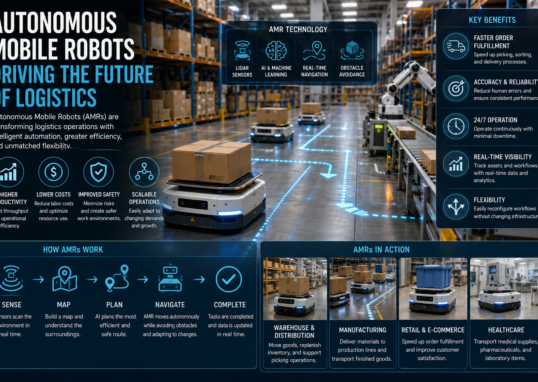
Autonomous Mobile Robots Driving the Future of Logistics
- 0
- 1,458 word
Autonomous Mobile Robots Driving the Future of Logistics – The logistics industry is experiencing a major technological transformation. As global commerce expands and...
Read out all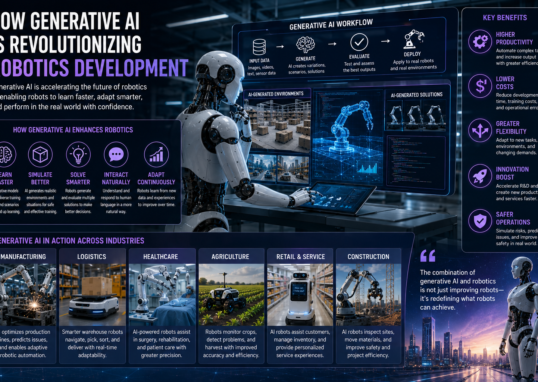
Generative AI for Robotics and the Future of Intelligent Machines
- 0
- 1,425 word
How Generative AI Is Revolutionizing Robotics Development – Artificial intelligence has already transformed countless industries, but one of the most exciting developments...
Read out all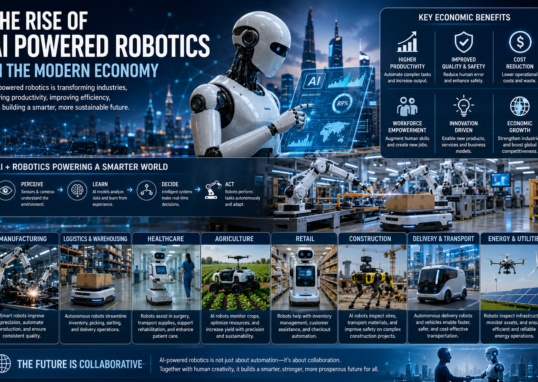
The Rise of AI Powered Robotics in the Modern Economy
- 0
- 1,510 word
The Rise of AI Powered Robotics in the Modern Economy – Artificial intelligence and robotics are two of the most transformative technologies of...
Read out all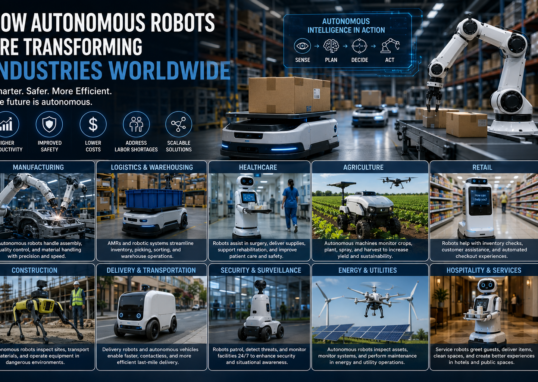
How Autonomous Robots Are Transforming Industries Worldwide
- 0
- 1,304 word
How Autonomous Robots Are Transforming Industries Worldwide – Autonomous robots are rapidly becoming one of the most influential technologies of the modern era....
Read out all