
- 0
- 1,258 word
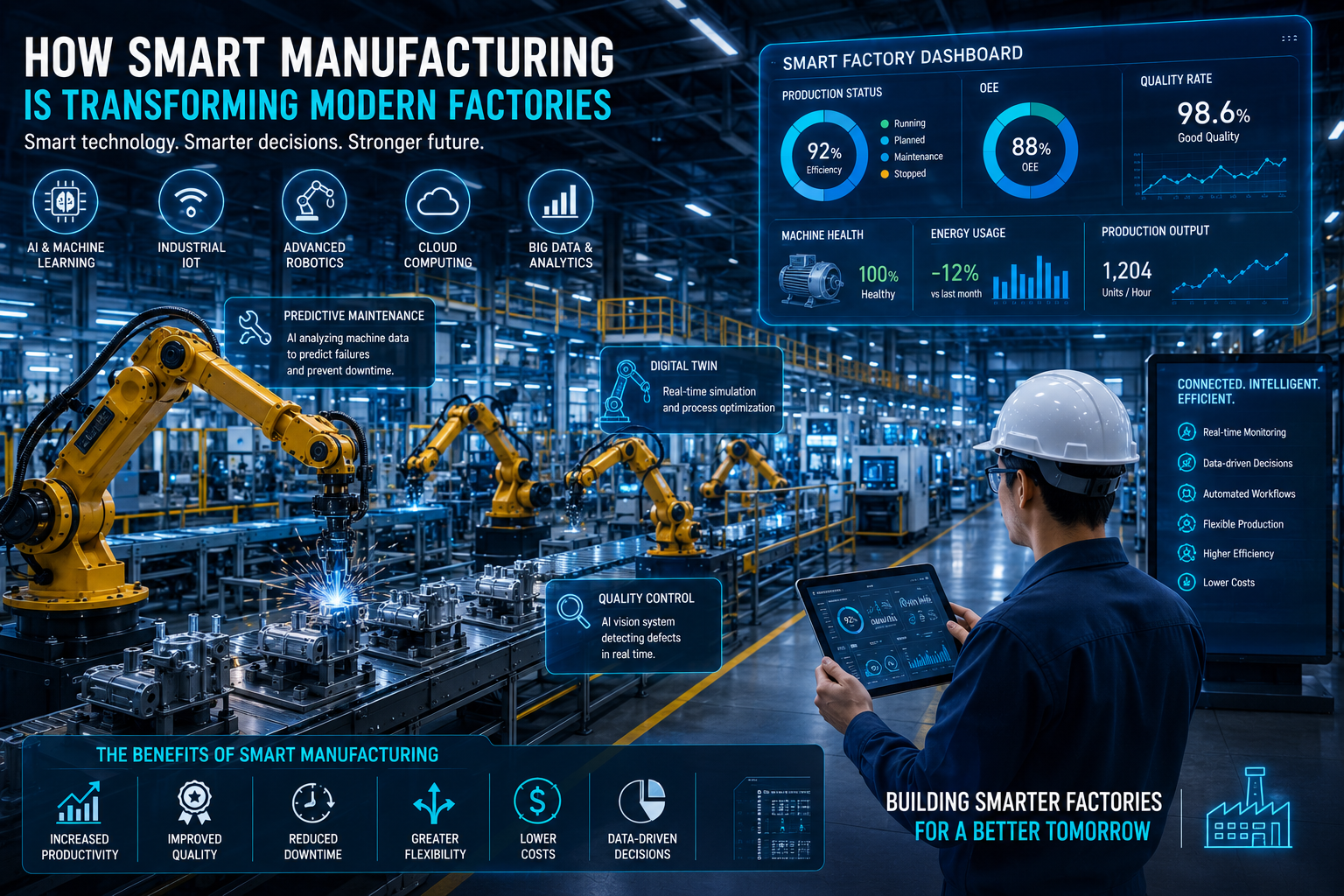
How Smart Manufacturing Is Transforming Modern Factories – The manufacturing industry is experiencing a profound transformation driven by digital technologies, artificial intelligence, and connected systems. As businesses face increasing pressure to improve productivity, reduce costs, and remain competitive in a global marketplace, traditional factory models are evolving into intelligent, data-driven operations. This shift is known as smart manufacturing.
Smart manufacturing combines advanced technologies such as artificial intelligence (AI), the Industrial Internet of Things (IIoT), robotics, cloud computing, machine learning, and real-time analytics to create highly efficient and flexible production environments. These technologies enable manufacturers to collect, analyze, and act on data throughout the production process, leading to better decision-making and improved operational performance.
In 2026, smart manufacturing is no longer a future concept. It is becoming a strategic necessity for organizations seeking to thrive in an increasingly digital and automated world.
What Is Smart Manufacturing?
Smart manufacturing refers to the integration of advanced digital technologies into manufacturing processes to improve efficiency, productivity, quality, and adaptability.
Unlike traditional factories that rely heavily on manual monitoring and reactive decision-making, smart factories use connected devices, sensors, software platforms, and AI-powered systems to continuously optimize operations.
Key characteristics of smart manufacturing include:
- Real-time data collection
- Automated decision-making
- Connected machinery and systems
- Predictive maintenance
- Intelligent robotics
- Advanced analytics
- Digital twins
- Flexible production environments
These capabilities allow manufacturers to respond more quickly to changing market conditions and customer demands.
The Evolution of Manufacturing
Manufacturing has progressed through several major industrial revolutions.
Industry 1.0
The first industrial revolution introduced mechanization powered by water and steam engines.
Industry 2.0
The second revolution brought electricity and mass production techniques, dramatically increasing manufacturing output.
Industry 3.0
The introduction of computers and automation transformed production processes during the late twentieth century.
Industry 4.0
Today, Industry 4.0 is driving the rise of smart manufacturing through connected technologies, AI, cloud computing, and intelligent automation.
Smart manufacturing represents the practical implementation of Industry 4.0 principles in modern factories.
Core Technologies Behind Smart Manufacturing
Several technologies form the foundation of smart manufacturing systems.
Artificial Intelligence
AI enables machines and systems to analyze data, identify patterns, and make intelligent decisions.
Manufacturers use AI for:
- Predictive maintenance
- Quality control
- Production optimization
- Supply chain management
- Demand forecasting
AI helps factories operate more efficiently while reducing downtime and waste.
Industrial Internet of Things (IIoT)
IIoT connects machines, sensors, and devices across the factory floor.
Connected equipment continuously collects data related to:
- Machine performance
- Production output
- Temperature
- Energy consumption
- Equipment health
This data provides valuable insights that improve operational visibility and decision-making.
Robotics and Automation
Modern factories increasingly rely on industrial robots and collaborative robots (cobots).
These systems perform tasks such as:
- Assembly
- Welding
- Packaging
- Material handling
- Inspection
Robots improve consistency, speed, and workplace safety while reducing repetitive manual labor.
Cloud Computing
Cloud platforms enable manufacturers to store and analyze large volumes of operational data.
Cloud-based systems support:
- Remote monitoring
- Data sharing
- Cross-site collaboration
- Advanced analytics
This improves scalability and flexibility across manufacturing operations.
Digital Twins
A digital twin is a virtual representation of a physical asset, machine, or factory.
Manufacturers use digital twins to:
- Simulate production scenarios
- Monitor equipment performance
- Predict failures
- Optimize workflows
Digital twins provide valuable insights without disrupting actual operations.
Benefits of Smart Manufacturing
Smart manufacturing delivers significant advantages for businesses across industries.
Increased Productivity
Connected systems and automated workflows help manufacturers produce more goods in less time.
Real-time monitoring allows companies to identify bottlenecks and optimize production processes continuously.
Improved Product Quality
AI-powered quality control systems can detect defects with greater accuracy than traditional inspection methods.
This reduces product failures and enhances customer satisfaction.
Reduced Downtime
Unexpected equipment failures can be costly.
Predictive maintenance systems use machine data to identify potential problems before they lead to breakdowns.
This helps manufacturers minimize downtime and extend equipment lifespan.
Greater Operational Efficiency
Smart factories optimize resource utilization, energy consumption, and production scheduling.
These improvements lead to lower operating costs and higher profitability.
Enhanced Flexibility
Modern consumers increasingly demand customized products.
Smart manufacturing systems allow manufacturers to adjust production lines quickly and efficiently to accommodate changing requirements.
How Smart Manufacturing Is Transforming Modern Factories
Real-Time Visibility
Traditional factories often operate with limited visibility into production activities.
Smart factories provide real-time dashboards that display:
- Equipment status
- Production metrics
- Inventory levels
- Quality indicators
- Maintenance requirements
Managers can make informed decisions based on current operational data rather than outdated reports.
Intelligent Production Planning
AI-powered planning systems analyze demand forecasts, inventory levels, and production capacity.
This helps manufacturers optimize schedules and reduce waste.
Intelligent planning improves resource allocation and increases overall efficiency.
Automated Quality Control
Machine vision systems and AI algorithms can inspect products at high speed and accuracy.
These systems identify defects that may be difficult for human inspectors to detect consistently.
Improved quality control reduces returns, warranty claims, and production losses.
Energy Optimization
Energy costs are a major concern for manufacturers.
Smart systems monitor energy consumption in real time and identify opportunities for efficiency improvements.
This supports sustainability goals while reducing operating expenses.
Human-Robot Collaboration
Collaborative robots are designed to work safely alongside human employees.
Rather than replacing workers entirely, cobots assist with repetitive and physically demanding tasks.
This allows employees to focus on higher-value activities such as problem-solving and innovation.
Smart Manufacturing Across Industries
Automotive Manufacturing
Automotive companies use smart manufacturing technologies for:
- Robotic assembly
- Predictive maintenance
- Automated inspections
- Supply chain optimization
These capabilities improve production speed and quality.
Electronics Manufacturing
Electronics production requires precision and consistency.
Smart factories use AI and robotics to assemble complex components with exceptional accuracy.
Food and Beverage Production
Smart manufacturing supports food safety and efficiency through:
- Automated packaging
- Quality monitoring
- Inventory management
- Production tracking
These systems help manufacturers meet strict regulatory requirements.
Pharmaceutical Manufacturing
Pharmaceutical companies rely on smart manufacturing to ensure accuracy, compliance, and product safety.
Automation improves consistency while reducing human error.
Challenges of Smart Manufacturing
Despite its benefits, smart manufacturing also presents challenges.
High Initial Investment
Implementing advanced technologies requires significant upfront investment.
Many organizations must carefully evaluate return on investment before adopting smart manufacturing solutions.
Cybersecurity Risks
Connected systems create new cybersecurity vulnerabilities.
Manufacturers must protect critical infrastructure from cyberattacks and data breaches.
Workforce Transformation
As factories become more digital, employees need new technical skills.
Organizations must invest in training and workforce development programs.
System Integration
Integrating new technologies with existing equipment can be complex and time-consuming.
Successful implementation requires careful planning and technical expertise.
Future Trends in Smart Manufacturing
Several emerging trends are expected to shape the future of smart factories.
AI-Powered Autonomous Operations
Factories will increasingly use AI to automate decision-making and optimize production without human intervention.
Advanced Robotics
Future robots will become more intelligent, adaptable, and capable of performing complex tasks.
Edge Computing
Processing data closer to production equipment will improve speed and reduce latency.
Sustainable Manufacturing
Smart technologies will help manufacturers reduce waste, conserve energy, and achieve environmental goals.
Digital Twin Expansion
Digital twins will become more sophisticated, enabling deeper insights into factory performance and optimization opportunities.
Conclusion
Smart manufacturing is transforming modern factories by combining AI, robotics, IIoT, cloud computing, and advanced analytics into connected, intelligent production systems. These technologies enable manufacturers to increase productivity, improve quality, reduce downtime, and respond more effectively to changing market demands.
As Industry 4.0 continues to evolve, smart manufacturing will play an increasingly important role in shaping the future of global production. While challenges related to investment, cybersecurity, and workforce development remain, the long-term benefits are driving rapid adoption across industries.
Organizations that embrace smart manufacturing today will be better positioned to compete in a future where efficiency, flexibility, and innovation are essential for success.
Author

96livemarketing@gmail.com